
If you were privileged enough to grow up in an Italian household, you are well-acquainted with the pasta board. This basic sheet of wood, akin to a giant cutting board, existed for the sole purpose of making pasta. It was the seasoned work surface from where a simple mound of flour with eggs was transformed into the wonders of fettuccine, spaghetti, lasagna, ravioli, tortellini, cappelletti, and so on and so on.
When I was little, my mom made homemade pasta almost every week. Her pasta machine had some serious miles on it! Once that baby was fastened to the edge of the pasta board, it was time to get cranking! The hand crank made an undeniable sound as the pasta was fed through the machine’s rollers and flattened, stretched, and shaped. As a child, it was always fun to be the one whose job it was to turn the crank and watch the pasta sheets come out the other end of the rollers. It was even more fun turning it as fast as you could to see how quickly the sheets rolled through…though my mother was always less than amused.
Today, I have my own pasta board. Mine is on the fancy side as my father fashioned it to slide over one end of the island in my kitchen like a sleeve. I have to say that whenever I attach my little red pasta machine to the one end, I am instantly transported back to my mom’s kitchen where I eagerly knelt on a chair watching the whole process and waiting to do my job…and it is now my boys who eagerly watch and wait.
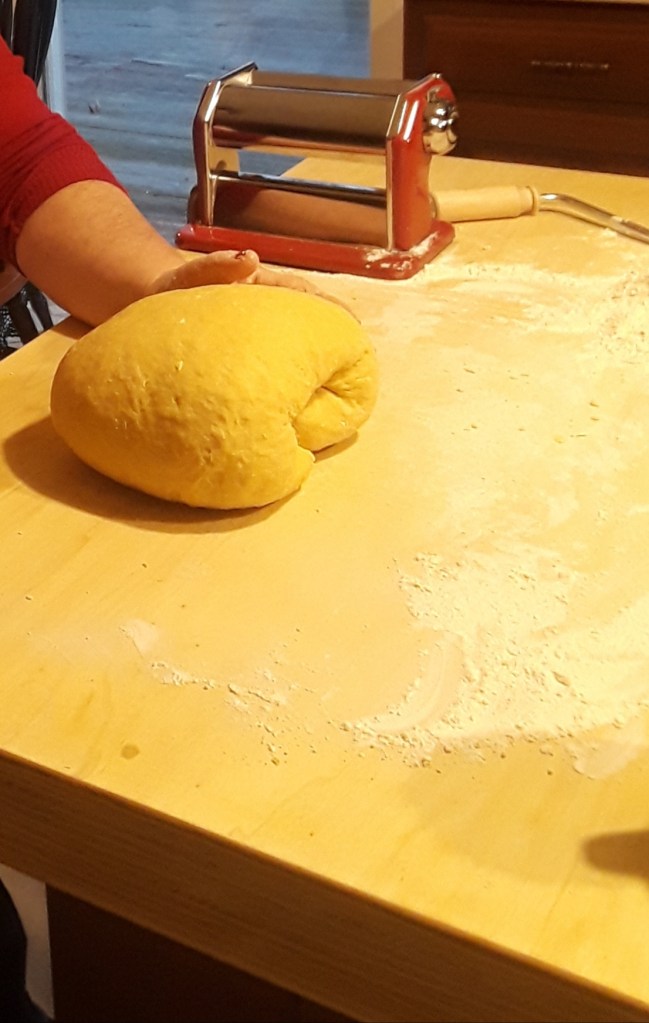
During this time of quarantine, my pasta board has certainly seen some action. Now I am not going to lie…the process is messy. Your hands will get dirty and the floor will be dusted with flour. You will question if what you are doing is right. But I promise that the taste and texture of fresh homemade pasta is well worth the effort (and mess). There is no comparison between a lasagna made with homemade pasta sheets and one that is not. Homemade spaghetti or fettuccine cook in 2 to 3 minutes and make any sauce 100 times better.
To make homemade pasta you will need : 3 3/4c all purpose flour (unbleached), 4 eggs, and a drizzle of olive oil. Starting off with less flour is better, because you can always add more. Begin with a mound of flour and a well in the center (built in bowl!). Break the eggs directly in the well, add the olive oil, and beat with a fork. Slowly add the flour to incorporate, and then get your hands dirty. Knead the dough by pushing with the heels of your palms. Fold the dough onto itself and continue kneading until the dough is uniform and elastic. Cut into smaller quarters so that it can be rolled easily. Keep the sections not being used in plastic wrap or under a bowl. When rolling the dough through the pasta machine, begin with one piece of dough through the widest setting first. Roll it through 2 to 3 times before adjusting the rollers to thinner settings. Be sure to dust with flour before proceeding with each roll setting. I usually stop at the second to last setting for ribbon pasta. Allow the long sheets to lightly dry before cutting the pasta into shapes with the pasta machine. I typically lay the long sheets on a kitchen table covered with a table cloth and proceed cutting when all of the dough has been rolled into thin sheets.
Gone are the days where pasta-making was a weekly endeavor. And unless your Mamma or Nonna are still around, the chances of having a pasta board are slim to none. But if you are fortunate enough to at least own a pasta machine, don’t be afraid, take her out, and go for a spin.
Buon appetito!
 Curls and Carbs